• Innovative First Editions: Hamburg Bird Watching Guides with Local Expert Support

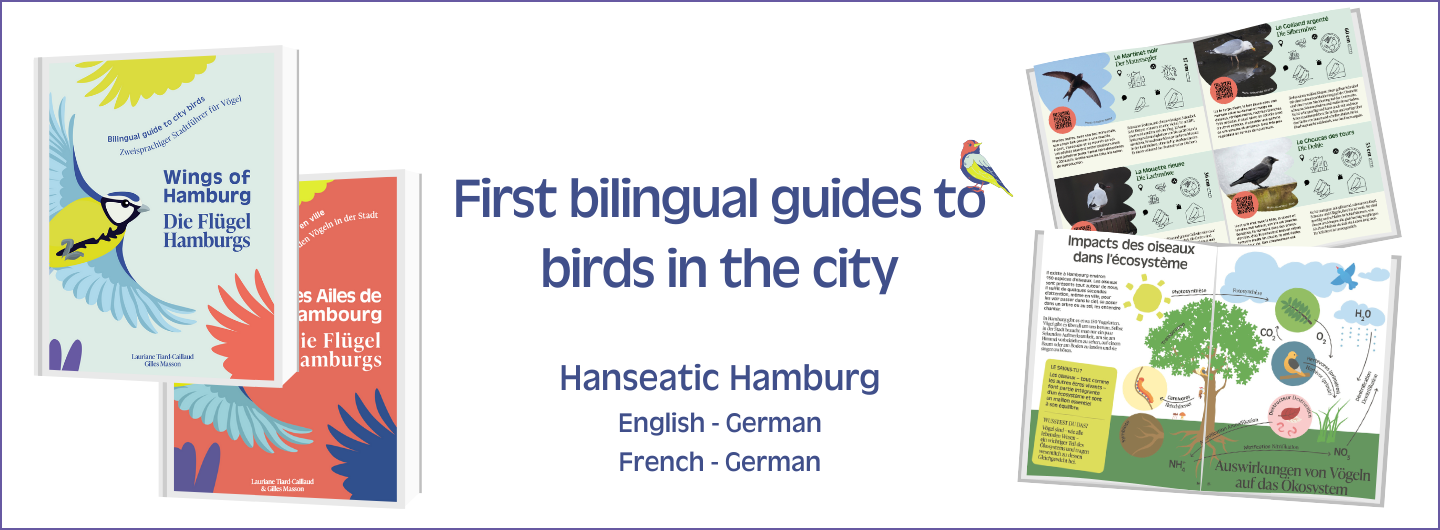
    After months of silence and passionating work, the two launch editions of our concept have been released: Wings of Hamburg and Les Ailes de Hambourg, the first bilingual guides to the birds of the city.

    First-ever bilingual litterature about birds of Hamburg, available In English-German and French-German, presents the 43 most visible birds.

    The concept aims to bridge a powerful gap for international people: acquiring the local language of nature to be conscious of its existence surrounding us. 

    We developed the first editions about Hamburg because it is our city: it is joyfully green and offers multiple water spaces: rivers, canals, lakes, and ponds. It also has numerous parks and gardens, which creates a large bird population. The story starts with bird watching as it is a diverse, visible and unanimously enjoyable part of urban nature.  

    I was not a particularly educated person on bird watching, even though I loved it. It was exactly what was needed to get this project running: I did not know enough to imagine its limits

    This candour, not to say naïvety, brought fresh air on the traditional vision of a book about birds. Going towards the concept of essential information and beautiful explanatory designs rather than precise, detailed and long content. We aim to invite to discover more through other – more specialised – content.

    We also got the support of the community of local ornithology experts: they welcomed something new, targeting a broader audience and embracing cultural differences. They gave their time and expertise, reading and commenting, and offering photos and information. We are extremely grateful to feel this support. 

    As of the 28th of May 2024, the books (and some by-products) are available for sale here : https://les-ailes.de

    We are hoping to broaden our concept with other editions:

    • Other flora and fauna
    • Other languages
    • Other Cities

    Do not hesitate to get in touch if you wish more details.

  • Collect Moments, Not Things

    Why the need to possess instead of the desire to belong?

    When searching for a present for my family for Christmas, I hoped to offer them something “nice” and not just “another thing”. Christmas is always a milestone, it brings the family together and the year to an end, hoping to reflect together on what comes next. It never seems to be associated with a lamp, accessories, or T-shirt.

    I’ve never been keen on acquiring material possessions, not for myself either. I often find the time spent in shops to be a waste of precious life moments. As well as spending hard-earned money only to give it back, I feel the weight of unused items piling up around us, creating clutter in our daily lives and in our minds.

    Some of my close friends and family still believe in the necessity of things, mainly for professional or social reasons, or to fill a perceived void. We’ve all experienced or witnessed first-hand how shopping and food become traditional compensations for all the inconveniences life can bring. I’ve seen the consequences and the weight of hoarding.

    “I can leave any place in 24 hours, with one suitcase, as long as my wife is with me.”

    My father

    Things matter only to the extent that we know why they are here and serve a practical purpose in our lives—or as Marie Kondo puts it, bring a sense of joy.

    A few years ago, I discovered the Minimalist movement, which articulates the need to declutter and create space in life, both physically and mentally. I firmly believe in this principle; limiting the mess around us offers more peace of mind.

    Here are some tips we have adopted:

    1. Invest in items, and only consider good quality, as you will live with it for a few years.
    2. Embrace a policy of no new things, only replacements. Not everything needs to be replaced; consider the necessity first as usage changes and life evolves.
    3. Practice patience, especially with children who tend to forget half of the things they want and change their minds about the remaining half. I let them ask a few times over a few weeks before buying a new item. 
    4. Prioritise spending on creating moments rather than things. If you need to hold something in your hands, cultural products such as books and music, group games offer great alternatives and bring joy to our days.

    So for Christmas this year, we are offering the family to share a unique experience, traveling in time to visit the Chateau de Versailles during the Louis XIV period. Let’s hope it will be a moment to remember! 

    Merry Christmas to all and – hopefully – see you next year! 

  • ESRS is out – the significance of Double Materiality Assessment

    Now that the Delegating Act for ESRS is out, we have observed the analyses presented by all consulting firms (refer to sources) to outline what is and is not in the current set of non-financial reporting requirements.

    Primarily listed, we can summarize that the ESRS requires 84 disclosure requirements and over 1000 qualitative and quantitative data points. This significantly increases the level of detail, notably in the value chain. However, there has been commendable work done to ensure interoperability between the GRI/ISSB. There are still some gaps and differences in the definitions, but it is closer than in the ESRS draft.

    As anticipated, the negotiations have resulted in a reduction of the time pressure on the provision of some data points for firms with fewer than 750 employees, and the double materiality assessment is here to confirm the absence of materiality for some data points.

    What is double materiality?

    Principles of materiality: the topic on which the activities of a business have an influence.

    1/ Financial materiality: companies report on the financial materiality of their businesses, estimating potential risks and assessing opportunities for their investors.

    2/ Impact materiality: companies report on their impact on the environment and communities, positive or negative, in the short or long term. This assesses the influence of their activities on the communities as well as on the planet.

    ESRS connects ESG with financial reporting by requesting information on the anticipated financial effects of sustainability, as the material has an impact on the business AND an impact outside. It aims to compel companies to gather a holistic view of their sustainability footprint and broaden their risk assessment to new factors that enhance their business resilience.

    Why is double materiality key?

    Only the general requirements are mandatory; the double materiality assessment will be key to defining the number of topics on which the company has to report. It has to be seriously approached to justify what is not reported.

    The double materiality assessment is the keystone of a new strategic approach influencing not only finance but also operations, supply chain, and planning, etc.

    1 / It helps companies identify the risks and opportunities linked to sustainability that could affect their financial performance and the impact of their business operations on the environment and the communities or society around.

    2/ It influences future strategic decision-making by enlarging the volume of areas that the company can be accountable for. More stakeholders than before are empowered to take part in the decisions, putting pressure on companies to act responsibly, and it brings the markets to adhere to new standards, under the scrutiny of more eyes.

    It opens the way for ambitious companies to achieve a leading position on the future market as more and more sustainability, transparency, and accountability are in the investors’ and clients’ spotlight.

    Why not wait for 2025?

    From the 1st of January 2025, there is an extremely large number of data points from 2024 to report on. 

    This information has to be reliably gathered and checked, organised, and analysed.

    Double materiality helps to select what can be left out, but it also has to be justified and proved. The team requires understanding this data and acquiring experience in assessing the quality of the information provided, as well as being capable of acting according to the conclusions of their analysis.

    Bringing managers and employees up to speed on the evolution is key to succeeding in this transition. It is not only the role of the Finance and Sustainability department to align but the entire firm to envision where the company wishes to go. The double materiality assessment offers the possibility to focus the internal training energy on a series of initial topics that can open the way to better anticipating.

    How to kick-start the process? Connect with the company’s stakeholders.

    Choosing the right ESG topics is a collaborative exercise; it is an opportunity to start positive relationships with stakeholders. It can be a challenge to launch this process but brings a supportive environment when setting the right ESG material themes on the table. Stakeholders are the users of the reporting and those influenced by the company’s activities. They are crucial in shaping the map of themes through their needs and shared interests that will become material in the reporting.

    To address stakeholder engagement, the company may wish to invest in cross-functional teams, adding corporate communication and risk management to their current financial/sustainability reporting effort. The discussions will bring to light not only the themes but their importance on the timescale (short-term, mid-term, long-term) and risks for the company. It would prioritise the data to be gathered and analysed and the quality of what can be provided. It will highlight where the gaps are and how to address them.

    Leverage robust data gathering and management architecture to guarantee the quality and reliability of your data. Establish relevant tools and teams to analyse the data. Create communication paths that are trustworthy, supporting stakeholder information and relationship nurturing.

    Stakeholder mapping and engagement are part of the ISO 26000 system management in which I am certified. With your cross-functional team, I can help you launch the initiative to build your community engagement. Be in touch!

    Sources
  • Sustainable Eating – Part 3: Diversifying Proteins

    This post is a part of a presentation initially written in French, and presented during the monthly reunion of the collective I organise with one of my dear friend Julie Goudet. We bring together the french community in Hamburg to provide Educational talks and trainings about Sustainability and protection of the biodiversity.


    There are many other topics in the field of sustainable eating, but the impact of meat is so present that I will end the series with it. Here the numbers speak louder than words.

    The Heavy Footprint of Meat Production:

    Let’s start with a staggering statistic: a whopping 89% of emissions from agricultural production are linked to the production of meat, eggs, and dairy products. It’s not just about the sizzling steaks and creamy cheese – it’s about the environmental toll they take. The culprits? Methane emissions from ruminant digestion, CO₂ emissions from deforestation, and nitrous oxide emissions from synthetic fertilisers used in intensive agriculture and animal waste. It’s a triple threat to our planet.

    Land Use Dilemma:

    Land, a precious resource, is also heavily impacted. Animal feed accounts for a significant chunk – approximately 79% of the world’s consumption of plant proteins. Oil cakes, cereal grains, and cereal co-products dominate the scene, with oilcakes leading the pack at 112 million tonnes. To put it into perspective, it takes around 9.2 kg of plant protein (including fodder) to produce just 1 kg of animal protein. A stark comparison when we consider that proteins directly consumable by humans have a ratio of 1 kg of plant protein to 1 kg of animal protein.

    Human Protein Requirements:

    Now, let’s address the age-old question – meat or not meat? According to health guidelines, protein requirements vary based on age, activity level, and life stage. For instance, a sedentary person needs around 0.8g of protein per kilo of weight per day. However, the debate rages on about the necessity of meat, eggs, or dairy for good health. The complexity arises from the lack of conclusive evidence on the difference in quality between animal and vegetable proteins.

    Flexitarianism: A Green Approach 🌱

    Enter the era of flexitarianism – a dietary approach that embraces diversity intake beyond pure vegetarianism. Studies abound with evidence supporting the benefits of reducing meat consumption for both personal health and the health of the planet. But what does this look like in practice?

    Consider none-meat proteins (with protein content per 100g) :

    Product g protein/100 g cookedKg CO2 eq./100gKg CO2 eq./100g impact for a daily protein ration for an adult weighing 80kgquantity in grams to be consumed per day for an adult weighing 80kg
    Avocado1,560,2510,44166,7
    Potato1,60,052,04062,5
    Peas50,11,31300,0
    broccoli40,050,81625,0
    Chick peas8,30,21,6783,1
    Coral lentil10,60,21,2613,2
    Green lentil10,10,21,3643,6
    Tofu14,70,080,4442,2
    Kidney beans9,60,151,0677,1
    Brussels sprouts40,050,81625,0
    Kale4,30,050,81511,6
    Spinach3,20,0350,72031,3
    Button mushroom2,20,0150,42954,5
    Green bean20,26,53250,0
    Emmental cheese27,92,796,5233,0
    Morbier saint nectaire222,798,2295,5
    camembert202,799,1325,0
    mozzarella162,7911,3406,3
    feta cheese142,7913,0464,3
    Greek yoghurt40,243,91625,0
    Egg130,532,7500,0
    Chicken271,824,4240,7
    Beef2115,548,0309,5
    Lamb195,8420,0342,1
    Banana10,117,26500,0
    Rice30,163,52166,7
    Pork282,45,6232,1
    banana1,060,116,76132,1
    orange0,750,054,38666,7
    Overview of the Protein to CO2 equivalent

    Theory into practice -> Recipes for a Greener Plate:

    For the same amount of Protein – 50% of the daily recommended intake of a 80kg adult:

    • Salad from home:
      • Ingredients: Chickpeas (200g), Feta cheese (100g), Spinach shoots (100g)
      • Carbon Footprint: 3.25kg CO2 equivalent
    • Steak and Chips at the Restaurant:
      • Ingredients: Steak (150g), Chips (150g)
      • Carbon Footprint: 23.325kg CO2 equivalent

    As we navigate the intricate web of environmental impact and dietary choices, it’s clear that moderation and diversification play key roles. Whether you’re leaning towards a flexitarian or vegetarian lifestyle, every bite counts in shaping a sustainable future. So, let’s raise our forks to greener, healthier choices – for us and the planet!

    Sources 

  • Sustainable Eating – Part 2: Cooking Seasonal 

    This post is a part of a presentation initially written in French, and presented during the monthly reunion of the collective I organise with one of my dear friend Julie Goudet. We bring together the french community in Hamburg to provide Educational talks and trainings about Sustainability and protection of the biodiversity.


    To follow up on the sustainable eating, we would like to step into another important and positive impact solution : seasonal eating. Isn’t it fantastic to see the first strawberry landing on the market stalls ? 

    As you know, Our food choices wield immense power over the health of our planet. According to a recent United Nations climate and environment report, our global food systems bear the weight of responsibility, contributing to over a third of greenhouse gas emissions linked to human activities. As mentioned as intro of our series: the shocking profligacy of wasting food. The Waste Report 2021 has unmasked a staggering truth: a colossal 931 million tonnes of food are squandered globally. As we dive into the world of eating in season, it’s crucial to bear in mind the environmental repercussions of our choices, not just in what we consume but also in what we discard. Now, armed with this awareness, let’s explore how we can make a difference through mindful, seasonal eating and curb the unnecessary extravagance of food waste. 🌍✨

    The ecological cost of permanent access:

    Sure, having tomatoes and strawberries on our supermarket shelves throughout the year may seem like a modern marvel, but it comes at a cost – a significant ecological cost. 

    The constant demand for out-of-season produce leads to water and soil exploitation, impacting regions like Southern Spain. The documentary “En Andalousie: Plongée dans l’enfer des serres de la tomate bio” sheds light on the environmental toll of year-round cultivation (check it out here: Le Monde). Organic farming, even with 25% of the land dedicated to it, is struggling to mitigate the consequences.

    The Solution: Eating in Season 🌱

    To navigate the maze of seasonal eating, here are two practical ideas and how to put them in practice:

    1/ Know What to Eat When:

    • Consult local seasonality guides for your country, for Europe https://www.eufic.org/en/explore-seasonal-fruit-and-vegetables-in-europe.
    • Direct from Producers: Embrace platforms that connect you directly with producers, such as crowdfarming. It’s a win-win – you get fresh produce, and farmers get fair payment, you know what comes to your plates.

    2/ Stocking up for Winter:

    • Off-season fresh veggies and fruits have also the tendency to be very expensive. Instead, consider preserving the goodness of summer: canning your favourite vegetables and fruits are a sustainable option. Learn the art of preserving with resources like Le Parfait if you have the time and inclination and all recipes too 
    • Freeze your favorites: Don’t let your summer harvest go to waste. Freeze surplus fruits and vegetables – they can last for up to 12 months. Pro tip: Courgettes are good for 4 months, while carrots can be frozen for up to 8 months.

    Eating in season isn’t just a culinary trend; it’s a commitment to sustainability. By aligning our diets with nature’s calendar, we can reduce our ecological footprint and support local agriculture. It is also bringing us back to the pleasures of waiting for these little pleasures that each seasons bring back. 

    Sources