• Cookie Life – Part 5: Universal Identifiers

    I wrote this article as part of a series published on the Mercury Media Technology GmbH blog.

    As presented before, the technology behind cookies has made digital advertising extremely efficient. By offering precise information on consumer preferences and behaviours, advertisers could select the personas and demographics which best fit their product to maximize the ROI. 

    Publishers needed to provide the right environment to motivate these audiences to dwell on their platforms, within or outside the walled gardens.

    As explained in Part 3 of the series, it is possible to find alternatives avoiding the use of cookies. However, this would mean that agencies and clients have to agree to consider these alternatives as potential opportunities to grow differently, then test them for validation purposes. 

    Why need cookie alternatives like universal identifiers?

    As mentioned in our article about the current cookie status quo => Simple. Money. 

    When cookies are gone, it will be impossible to directly identify website visitors based on their browser history.Therefore, it will be unfeasible to serve them personalised ads adapted to their profile. 

    For advertisers, this will limit the capacity to attribute, target and monitor campaigns. 

    => Not wasting money and making more money. 

    It is a question of targeting for advertisers – not wasting advertising money on audiences who would never consider or buy their products or services. When an advertiser chooses to bid “blindly”, it will buy cheap impressions but its cat food ads can be served to dog lovers, which would be pure waste. One can say that some products – like washing powder or shampoo – can actually be served universally, but Italian luxury brand Salvatore Ferragamo used the Times’ first-party demographics and interests data for segmentation to drive a 0.47% CTR in its campaign (Source: WARC) – i.e. 9.4 times higher than the IAB benchmarks costs.

    For publishers, it is a question of revenue. An identified bid request is paid way more than an unidentified one. Offering no visitor segmentation whatsoever diminishes the quality of ads served in the specific ad slot too and requires diversifying sources of income – the ad slots – to maintain the revenue, which decreases the general content quality of the website. 

    An individual publisher, however big it is, cannot create the same audience group or interest pool as the walled gardens with its visitors alone, therefore potential collaboration with others is beneficial. That is the reason why the universal identifiers came around – the status quo that the industry needed to find new ways to scale. 

    “We don’t want one ID, but we also don’t want 20 plus either”. Mathieu Roche, CEO and founder of ID5

    How do universal identifiers work?

    The goal is to be able to keep following users across the web. Why? Because it enables the control over the number of exposures and successful touchpoints of each advertising campaigns. 

    Users are now connecting digitally through devices beyond mobile and desktop, fragmenting the market further. They are now exposed to ads in various channels and marketers aim to maximise the efficiency of their activities at the cross-channel and cross-device level. 

    Moreover, the pressure to respect privacy of each user is growing and being enforced more rigorously.

    Two types of identifiers have emerged on the market:

    – Deterministic

    These identifiers are a combination of the first-party website ID and hashed and encrypted PII such as an email address or telephone number. This kind of ID will remain open and ubiquitous while introducing significant upgrades to consumer privacy (compliant with privacy laws) and transparency. 

    The problem for now is that this technology needs to be scaled in order to be properly applied: the capacity to match the IDs across platforms depends on the adoption rate (the number of participating publishers) – the larger the group of publishers using them, the more relevant and ubiquitous their data will be. 

    – Probabilistic

    Providers are using machine learning algorithms to extend the ID with signals such as clicking, visiting a page, or buying products. It is mirroring the ID partners from its sources to other ID-sourced partners to offer broader identification opportunities. 

    The idea itself is great and could compensate the scalability problem that the deterministic IDs have. 

    Some of the competitors on the market

    MMT - Example of universal identifiers available

    Ok, now. What should marketers do about universal identifiers?

    The problem is, we do not know yet what the future holds and which ID solution(s) will prevail. The market is going through a transformation and the landscape is still shaping itself but marketers should not sit around and wait until they see the results. 

    As explained in this series, strategies and solutions are already available to go beyond the third-party cookies, and identifiers are one of the possible solutions under development that marketers need to keep track of. 

    Brands have a role to play in building tomorrow’s market by joining the conversation and ensuring that the different technologies can work with one another. 

    Any provider has to be transparent about its privacy compliance, hence the technology behind the identification. Marketers should get familiar with the technologies and solutions in order to avoid surprises, understand limitations and be comfortable with market changes. 

    As for the walled gardens, advertisers should not build a dependence on a single source of audience insights for campaign efficiency assessment. 

    MMT Consulting can help marketing teams assess their dependence on third-party solutions and provide recommendations on how to create the most relevant future-proof data-driven solutions to run your marketing campaigns. MMT is independent from any providers, keeping an agnostic point of view adapted to advertisers’ and agencies’ needs. Get in touch! 

    Sources

  • Cookie Life – Part 4: Data Clean Rooms

    I wrote this article as part of a series published on the Mercury Media Technology GmbH blog.

    As part of our series discussing the evolution of digital advertising triggered by the concerns about privacy on the web, we have published articles on how to target consumers without third-party cookiesand how to start collecting first-party data. This piece aims to clarify how you can benefit from data clean rooms when you use your first-party data for advertising purposes. 

    Content:

    • What are “data clean rooms” in the context of advertising? 
    • How do data clean rooms work?
    • Why set up a data clean room for your company?
    • How to get started with a data clean room?
    • What are distributed clean rooms?
    • What are deficiencies of data clean rooms?

    What are “data clean rooms” in the context of advertising?

    The name “clean room” originates from manufacturing sites that require extreme protective measures to prevent contamination. 

    Definition Data Clean Rooms

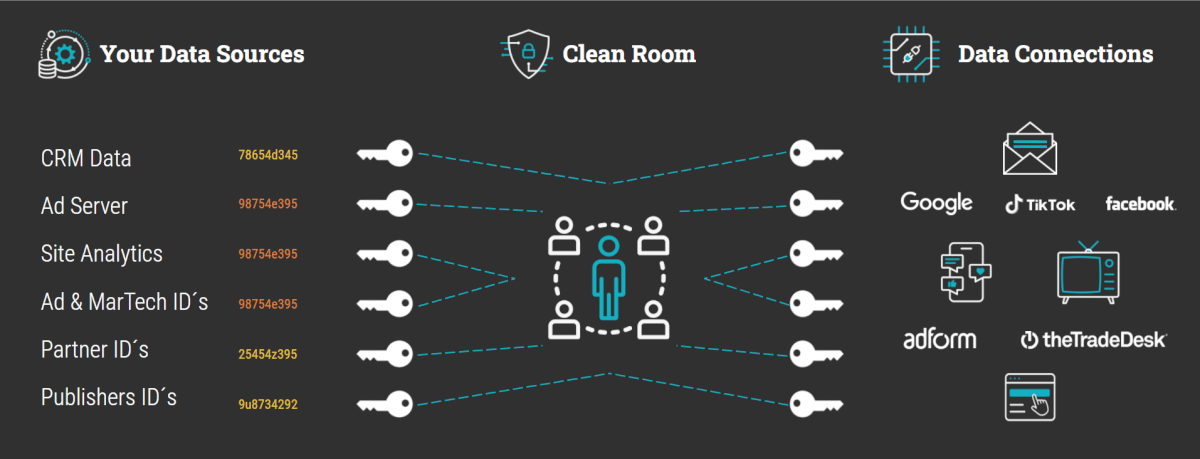
    data clean room in advertising is a safe space that offers access to sets of aggregated & anonymized PII data that can be cross-matched for measurement, analytics, and targeting purposes.

    Foggy? Let start with some explanations: 

    • Safe space: privacy-first closed-environment with pre-defined requirements to keep the data anonymized.
    • Aggregated & Anonymized: individual first-party user information is #ed (read hashed for unrecognizable characters) and grouped by clusters. No cluster can be limited to an individual or a few profiles. 
    • Matching: level of relevance of the two distinct audiences, one versus the other. 
    • PII data: (Personally Identifiable Information) any information that can identify a user: email, phone number, name, etc.

    How do data clean rooms work?

    Let’s take an example! The most famous use case is the walled gardens: they have individual data from billions of users, but they only provide access to anonymized data in cohorts to the marketers willing to leverage it. Advertisers of all sizes can define target groups by selecting a set of variables, from location to interests. The profiles of users are anonymized, and the advertisers can see the delivery data but no individual identities (PII). A clean room is a “neutral“ storage in the sense that no personal data can be extracted by any stakeholders: in the case of walled gardens, the advertisers can leverage it without seeing the names and profiles of users, which solves the issue of user privacy. 

    If the advertiser has its own first-party data collection solution, it has the capacity to create its own cohorts. By building a proprietary solution or using partners available on the market, it can aggregate and anonymize its own data to match with other partners. No individual profile will ever be shared.

    Data Clean Rooms_mmt_Cookie Life 4

    Why set up a data clean room for your company?

    • Accessing data from partners without giving away your first-party data: Brands can protect the PII information they have been entrusted with by their customers and fans. Still, they can use it to find their alter-egos on the web (open or walled gardens) without any risks of breaching privacy laws. 
    • Scaling your first-party audience from the start: When you decide to ramp up your first-party data collection effort, optimising the strategy and acquiring a loyal customer base takes time. Clean rooms allow brands to multiply their audience very quickly. 
    • Assessing external partners based on the audience matching rate: Building the right partner synergies requires thorough scrutiny of both sides – the most efficient partners and audiences. 

    How to get started with a data clean room?

    Data clean rooms provide the right technical environment to apply your first-party data before interacting with other data sets. There are precise requirements to fulfill in order to connect CRM solutions to it. They need good quality data and good data governance to be used to the fullest, which may entail hiring data scientists and an analytics team to manage clean rooms. 

    To get you started in your setup, please consider the following: 

    • If you have already set your own tech stack, which clean room is compatible with it? If you have not started your first-party data collection, you may need to consider choosing your tech stack and clean room accordingly.
    • If you use the service of a network agency, which solution are they powered by? Most agencies have chosen a partner to power their media buys, it is worth checking with them. 
    • How competent is your current data science team in terms of leveraging the system? Clean rooms require specific efforts and their power needs technical skills to be properly unleashed.
    • Do not underestimate the legal aspects of data privacy and data sharing. It takes time and should be anticipated as part of all partners’ negotiations. 

    There are multiple providers in the market who help to set up a data clean room and analyze the various requirements and options available. We are there for you if you need first-hand help.

    What are distributed clean rooms?

    “Distributed”, or “decentralized” clean rooms means that different partners keep their databases on different platforms without the need to migrate, share or centralize the data – it can still be analyzed in a seamless way. 

    This concept is relatively new. For example, InfoSum lets advertisers load their CRM data into a personal “Bunker” whereas media owners can upload their addressable audience data into another “Bunker”. After that, multiple Bunkers can be virtually connected through anonymous mathematical representations, which enables audience matching and subsequent comparison of conversions to advertising exposure to attribute new conversions to specific channels and measure the efficiency of the campaign. 

    Data Clean Rooms MMT
    ©Kim Heisler

    Image based on Merkel’s graphic

    This distributed setup, however, implies difficulties with governance and security and should be handled professionally.

    What are the deficiencies of data clean rooms?

    Most data clean rooms nowadays are still limited to one specific platform, which means marketers cannot gain a full picture of a customer’s journey or trace cross-platform attribution.

    For example, the walled gardens only allow the use of their data on their own platform, thus forcing advertisers to focus their budgets on respective channels. But that may change in the future – and we will make sure we keep you posted. Stay tuned! 

    Sources:

    Special thanks to Lily T. who provided me with insider tips on clean rooms considerations.

    Some data clean rooms are available on the market:

  • Cookie Life – Part 3: First-party data collection strategy

    I wrote this article as part of a series published on the Mercury Media Technology GmbH blog.

    Although most businesses sighed with relief after Google announced its intentions to stop supporting third-party cookies two years later than originally planned, the need to rethink advertising strategies is still there. The only difference is that the subject has now been reclassified from “urgent” to “important”.

    Where large-scale targeted campaigns relying on third-party datasets were enabling both businesses and tech agents to make a fortune out of it, it is now time to adapt the digital marketing paradigm to the “new normal” and establish a first-party data approach. 

    As explained in the latest article, relevance can be a powerful partner: firstly, because it helps exploit the “contextual environment” and secondly because it provides the opportunity to rely on the clientele and consumers already interested in your brand, products, or services. Capitalizing on those who are already interested in you can be extremely beneficial, as you can leverage the data collected from these people – upon their willful consent – to secure your future success. 

    The Corona Pandemic has shown us that digitalization is not just necessary – it is essential to keep your company afloat. All digital spaces, both existing and newly created, can collect information about behaviors and conversion paths. Coupled with user identification, this information is unique to your business and it is a real gold mine. This requires collecting these data in a structured, secure, and exhaustive manner, employing an infrastructure capable of analyzing and using them properly. 

    Welcome to first-party data strategy!

    Content:

    • What can you possibly do with first-party data?
    • Why collect first-party data?
    • How to collect data?
    • How to set up first-party data collection?

    What can you possibly do with first-party data?

    “That is a good question!”. Why all this fuss? 

    The last few years have made client recruiting so cheap that many brands have lost the habit of retaining their own customers. I remember often thinking in the 2010s, “loyalty does not pay anymore”. Brands stopped rewarding their buyers for “staying with them”. 

    But yes, retention – or keeping your current customer happy – actually means creating value. 

    • Longer customer lifetime = higher customer lifetime value: your customer strategy can be evaluated in the long term, establishing the next sale and product upgrade cycle while keeping in touch with your customers. 
    • Lower cost of acquisition: building lasting relationships with customers instead of performing a series of one-off sales. 
    • Trust and advocacy/referral programs: leveraging this qualitative relationship to win new clients instead of purely relying on external factors. 
    • “En masse” personalization: defining customer clusters based on use cases may render one-on-one contact unnecessary since leveraging groups with similar tastes already offers a great personalization opportunity without extra costs.
    First-party data collection strategy_MMT

    Why collect first-party data?

    Collecting first-party data can be a huge task if handled without a structured approach. There are so many potential data collection routes that it is important to establish business objectives and be clear on the status quo to kick things off: What do you wish to achieve with this new knowledge about your customers and prospects? 

    Data strategy can be based on quite ambitious business goals but at the same time entail gradual development along with data maturity evolution in the organization. By launching this effort, your company will also avoid relying purely on external partners to achieve growth, such as walled gardens and third-party providers.

    How to collect data?

    There is no magic trick here: this effort would require collaboration across the entire organization: CRM, IT, Marketing and Sales will have to work together on this. It means not just an extra strategy layer – it is rather a change management project. 

    1. Assessment: What are the different owned contact environments where consumers and clients engage with your business? Is there any tech infrastructure in place to support information gathering, storage, and application? What are the current relationship platforms established with your clientele? Have you got a CRM system? Does it collect granular up-to-date information? 
    2. Defining the goals of your business behind this strategy.
    3. Providing the right tech base and expertise: it is not just about buying new SaaS solutions, but rather about creating the right combination of tools that will work together and connect you to external capacities. Internal staff also need to be engaged in the process and complete adequate training to ensure proper usage. 
      1. Consent Management Platform (CMP) to guarantee privacy alignment: align with global law + cross-platform and cross-device
      2. Storage and management => Customer Data Platform (CDP)must connect correctly with your marketing automation tools to be able to leverage the information stored.
      3. Data enrichment and usage: You may use a 2 or 3 step process to collect relevant client information like birthday date/gender or family status through prompt or loyalty programs in order to be even more relevant to them.
    4. Connection of your first-party data to external AdTech tools: we will explore this in a later article. 

    How to set up first-party data collection?

    1. Define a clear goal for your first-party data to make sure that you collect and store the right information to achieve it. The typical data to collect are the ones to help you understand what types of customers you have and how to maximize their lifetime value:

    1. Identifiers: “who” are your customers – emails, logins, postcodes, etc. 
    2. Interaction points with the brand (visit, referral, engagement, etc.).
    3. Transaction points (purchase, renewal, usage, etc.).

    2. Build an approach to study and structure these customers into clusters that can later be leveraged for marketing purposes, e.g.:

    1. High-value customers,
    2. Frequent buyers,
    3. Abandoners,
    4. Brand ambassadors,
    5. Interested non-users.

    3. Improve the relevance of your dataset via data enrichment campaigns using: 

    1. Login walls on the website,
    2. Registration in apps,
    3. Loyalty programs,
    4. Contests and surveys.

    4. First-party data connection with external platforms: The data can now be connected to providers of identifiers matching outside of your universe to target the consumers not only in your own universe but also on partner platforms and extend the reach with the creation of “lookalike” audience in walled gardens media. 

    5. First-party data connection with owned platforms:

    1. Sub-groups for personification at scale: give customers the feeling of being heard and understood. 
    2. Timely contact to renew or rebuy: take product cycle into consideration in parallel with transactional data to select the right message.
    3. Product suggestions and offers: create opportunities for cross-selling and upselling. 
    4. Active referral programs to win new customers. 

    6. Reward your customers for entrusting you with their information: 

    1. Keep it safe.
    2. Identify clearly the benefits they get from sharing their data.
    3. Be transparent about the ways you will use this information. 

    At MMT, we advise global companies around the topic of data usage, leverage that data to guide decision-making and establish data infrastructures. We help businesses to build their future growth through better insights into their media and advertising activities, including customer identifications. 

    If you have any questions, do not hesitate to get in touch with us!

    Sources:

  • Cookie Life – Part 2: Targeting without third-party cookie

    I wrote this article as part of a series published on the Mercury Media Technology GmbH blog.

    To follow up on the status quo on cookieless future, we would do our first dive on cookieless targeting as it offers an opportunity to launch very quickly.

    We will give here a quick look into what are these targeting options. How to leverage it properly and why contextual is the trendy solution that all media agencies are talking about.

    Which targeting relies on what? What is targeting? Which targeting is affected by third-party cookies?

    Definition Targeting

    Targeting means the precise addressing of target groups in online marketing. The most important prerequisite for this is determining the target group in advance of any advertising campaign. Advertisers have numerous options to target an online campaign precisely.

    To go back to the status quo article, I mentioned different targeting options currently in use. Let’s clarify which ones will remain alternatives in the future framework.

    MMT - Cookieless advertising - targeting option without cookies
    • SocioDemo: using sociological and/or demographic characteristics to target eg. Age group would be possible via Cohorts / FloC or opt-in data. We will cover it in part 3
    • Geolocation: relating to the use of lat-long positioning of the device use, this relies on realtime data that can be deactivated but do not rely on third-party cookie. 
    • Behavioural: privacy laws also aim at the capacity to follow users from one site to another. So this will be affected by the loss of third-party cookies. 
    • Time/season based: based on external circumstances- e.g connected to the weather forecast, time of the day, or temperature, it is not affected by cookies. 
    • Contextual: based on the content of the hosting page, this is not influenced by cookies. 

    Why contextual targeting is (once again) cool?

    The name is explicit – advertising in context – car insurance presented on a blog presenting car model reviews and comparisons. It is not new, we even used it before the internet existed! Yes, the print channel had Interest titles which was a great opportunity to talk to niche audiences. It is still used for specialized products like hobby groups or sport material aficionados. 

    It emerged in digital advertising in the same way as an offering to help focus advertising based on interest, digitally, it requires to employ a technology which recognizes index or “read” the content of the page to analyze its content and allocated it to a “context” group.

    Google Adsense (created in 2003 thanks to the acquisition of Applied Semantics) is a good example of the usage of contextual advertising solutions based on keyword-indexing. It has its detractors as it also created an enormous volume of sites uniquely design to attract Adsense ads by aggregating some other sites’ content on a topic, not bringing particular quality to the market. 

    The main benefit of contextual advertising is relevance: there is no need of knowing who the person is if you just need to know what she wishes. It is based on real-time interest instead of past behavioral data analysis. It increases the chance of conversion when approached properly (let’s talk about next) as it focuses on the theme of the content and not the person reading it, It is offering an alternative to all companies which have not started collecting their own customer’s data (let’s talk about that too). 

    How to leverage the targeting options that are not relying on cookies?

    As said, Google pushed back the end of third-party and many marketers sighed with relief. It is just an opportunity to ensure we do not fall behind. There is no time to waste in starting to develop internal knowledge of the most efficient channels for your brand outside of this cookie world. 

    One essential solution entails allocating a budget for a clear test and learn approach potentially using the SMART framework: Your general objective remains to understand which targeting is the most relevant to create awareness or convert to sales (as both are important to run on a long term focus) 

    1. Establish hypothesis
    2. Determine how you will measure success
    3. Define a time and budget limit
    4. Assess results 
    5. Share learning

    To make your “test and learn” budget in contextual advertising a success.

    • Adapt the creative to a contextual environment, relating to the right topic assignment rather than the consumer-centric approach.
    • Monitor closely the performance of each context and associated creative to learn which are the best matches.
    • Internal factors can play a role in each activity, do not hesitate to use granular monitoring solutions to deep dive into your results when needed.

    For context

    The scalability of the campaign also depends on the quality of the contextual sorting. IAB has released a list of general categories on which website pages can be classified. It offers an opportunity for any publisher to list itself in a category of content, but this is still generic. In contrast, the niche of a context can end up impossible to scale as not enough content will be available. 

    Good AI leverage Natural Language Processing (NLP) can now determine the sentiment of the pages which reduces the risk of brands being presented against non-relevant or offensive content. It avoids excluding entire categories out of fear of falling against the wrong news (e.g. breaking news section, user-generated content such as reviews and forums). There are good pre-bid solutions now starting to be integrated as part of the brand safety offer of adservers. Check your options. 

    For other external factors

    Build your company knowledge of the influence of external factors by approaching such categories with solid test & learn hypotheses and structure including the creative drawing a clear picture of this option for you. Depending on your service or product, the advertising can be tested on:

    • Location 
    • Weather 
    • Time of the day 
    • Period of the year

    It is worth paying attention to these factors when running campaigns, it can save you cash by adding an extra relevance layer to your campaigns. 

    To close

    Remaining independent from large providers is a strategic decision to make, whereas it is always possible to choose to rely on a walled garden solution to provide the required data to leverage. No company should feel doomed to adhere to the technological limitations dictated by the market. 

    Alternative targeting does not rely on third-party cookies can yield great performances once the understanding of the best approach is integrated. As it relies not on consumer-centric data, it requires assimilating a new mechanic and that implies testing. As long as Google offers time for that, there is not a second to waste in starting to build knowledge.

    The next stop will be, first-party data collection and leverage, stay tuned.

    Sources:

  • Cookie Life – Part 1: Status Quo

    I wrote this article as part of a series published on the Mercury Media Technology GmbH blog.

    Google announced at the beginning of July that it will postpone the launch of the Privacy Sandbox solution in Chrome to the “end of 2023” hence maintaining the support to third-party cookies. It gives the industry some air to implement their new strategies and arbitrage for future open-web campaigns. Let’s use this time to understand what is at stake. 

    Why is scraping third-party cookies from Chrome bringing so much trouble to the advertising industry?

    1. Because Chrome represents 65% of all web navigation (cf. Gartner) and 75% of mobile ones (cf Visual capitalist). 
    2. Google alone attracted almost 31% of the total US ad revenue in 2019 (eMarketer)  (2020 being disturbed by Corona) across all formats (display, search, video- desktop, and mobile) and the revenue is growing.

    Data collection and capacity to leverage it is becoming concentrated in the hands of a very few actors(such as Google, Facebook Group, and Amazon) due to the limitations that various data protection laws have triggered in the western world. 

    To set the scene, let’s double-click on the context:

    • What is Data Privacy Protection?
    • What is classified as Personal Data?
    • What are advertising Cookies?
    • What is changing after the Elimination of Cookies?
    • What are the Alternatives to Cookies?

    What is Data privacy protection?

    Multiple examples of privacy laws around the world (non-exhaustive list):

    • The European Union General Data Protection Regulation (GDPR) in 2016
    • The Personal Information Protection and Electronic Documents Act (PIPEDA) in Canada in 2018
    • The General Data Protection Act (LGPD) in Brazil in 2018
    • The Data Protection Act in the United Kingdom in 2018
    • The Personal Data Protection Bill in India in 2019
    • The California Consumer Privacy Act (CCPA) in California (US) in 2019
    • The Protection of Personal Information Act (POPI) in South Africa in 2020
    • The Data Security Law in China in 2021
    • Various privacy laws in effect in Australia 

    Something all these laws have in common is that:

    1. There are sensitive personal data that should be protected 
    2. Businesses can be held financially liable for the mishandling of data at different pipeline stages including secure processing, storage, and transfer (free or at a cost) 

    Commonalities of data protection laws

    Sensitive personal data should be protected. Businesses can be held financially liable for the mishandling of data at different pipeline stages including secure processing, storage, and transfer (free or at a cost).

    What is classified as Personal Data?

    Definitions vary from country to country, for example in Europe it says that personal data is any information that relates to an identified or identifiable living individual: 

    • Name and surname
    • Home address
    • Email address 
    • Identification card number
    • IP address
    • Advertising identifier of your phone
    • Health data which could be a symbol that uniquely identifies a person
    • Cookie-ID or location identifier

    What are Cookies?

    The identification cookies are files created by the websites you visit. They make your online experience easier by saving browsing information (the name or address of the site you visited, your ID, and timestamp). 

    There are two types of cookies:

    1. First-party cookies are created when one visits a website. They are set by the site shown in the address bar.
    2. Third-party cookies are created by other sites that own ads or images on the visited website.

    With technical cookies, sites can keep you signed in, remember your site preferences, and give you locally relevant content; such cookies do not require the user’s consent. 

    Third-party cookies provide support to advertising targeting: they enable the selection of ads according to behavior as well as historical partners identifying user’s interests and potential needs.

    First things first, let’s clarify what has happened to data collection via cookies:

    Advertisers rely on cookies to track behaviors across the open web. Cookies help follow users from one site to another to serve them with ads that are coherent with their actions. At the same time, cookies record what the users have already seen for future reference (for example, for retargeting purposes).

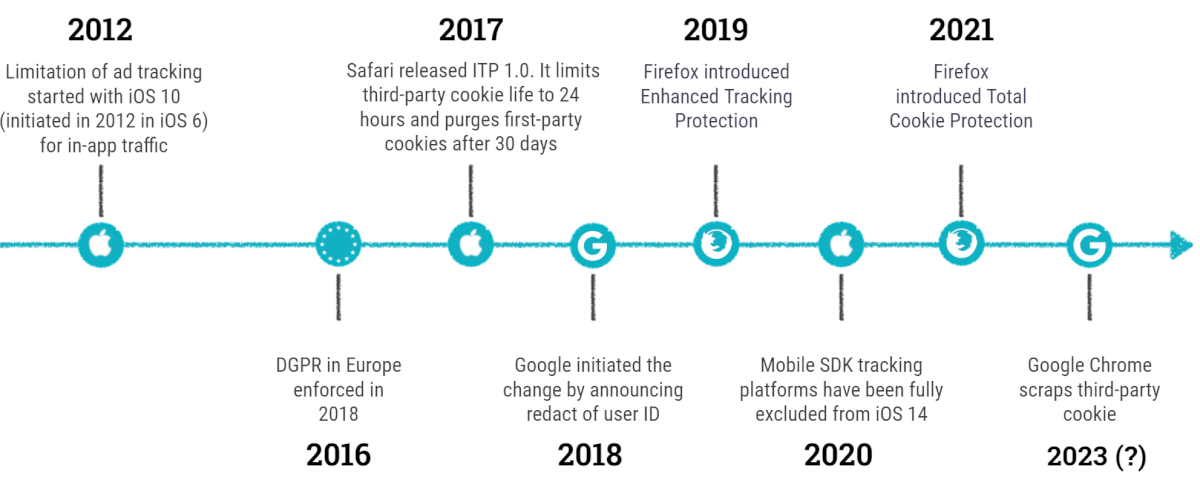
    Here is a timeline of the milestones on the path towards cookie eradication:

    MMT - overview of advertising cookies evolution that affects targeting

    What is changing after the Elimination of Cookies?

    The elimination of cookies compromises the measurement of campaigns on the web and cross-device attribution. We are turning to a consented information gathering: cookies will be saved in the browser and will get no access to the user’s history of actions prior to sending an ad. Campaigns will be running “blind” without any historical information on users.

    This entails the following:

    • It will incapacitate many actors involved in digital retargeting 
    • It will limit the ability to create lookalike and similar audiences based on collected first-party data 
    • Performance marketing activities, in general, are going to be handicapped
    • Lookalike and enhanced targeting will be limited 
    • Digital attribution models outside of walled gardens and cross-device targeting are going to be extremely limited.
    For advertisersLosing the base for attribution hence no capacity to build conversion funnelsDecreasing cost efficiency of digital campaigns
    For publishersLower ad revenue => need to find new sources of fundingConsent world for user identification
    For Walled GardensMonopolization of the identification capacityNew sources of revenue
    For Open Web data providersLosing the key source of revenue
    For end-consumersLower ad relevanceLess intense ad stalking


    What are the Alternatives to Cookies?

    The whole market is trying to find the most efficient solution to overcome this challenge, with or without leveraging Google’s new offer:

    • First-party data, e.g. email addresses are back as the golden ticket to recognize users across devices and platforms and collect user data
    • Walled gardens will keep offering the same level of granularity in targeting, thanks to the user consent upon login and personal data processing agreements. They have developed network outreach => advertising offers outside of their walls.
    • Cookie alternatives like various technological solutions aiming to replace cookies are already either available or in development. We are planning to give you an overview of these in the next articles. 
    • More traditional targeting options including contextual advertising, geotargeting, seasonality, and timing can be leveraged to guarantee some sense of going back to classic tactics – brands can rely on the specialized websites and relevance of influencers to promote their brands to the users, pending on season, hours of the days and locations, thus limiting wastage. 

    To close up

    The topic is ongoing – it is important to grasp the context to understand what is coming and build a customized solution for each individual business. There is no one-size-fits-all approach, as business needs and target group behaviors are genuinely different from one sector to another. This series of articles aims to help you navigate through the changes – MMT is here to help you build your #futureproof data solution.

    Sources:

    Link to legislative documents: