• Right message at the right time – is message more important ?

    I worked a great deal of my professional carrier in media, because I love advertising and branding! I have been brought up with TV as the window to the wonders of the world. Great advertising ideas still remains in my memory: baseline that have been repeated so many times that still today they identify with the brands in my head.

    When media vehicles were limited, just having budget to run ads would make the difference. Execution was limited : TV in 30s, one poster 4×3 and a portrait version for print…

    When media vehicles were limited, just having budget to run ads would make the difference. Execution was limited : TV in 30s, one poster 4×3 and a portrait version for print…

    Now media vehicles are fragmented, attention span is limited and the number of messages that people receive any day of the year are four fold : messaging counts way more.

    Now media vehicles are fragmented, attention span is limited and the number of messages that people receive any day of the year are four fold : messaging counts way more.

    It is not only the idea behind the creation, but also the delivery : the way the story is built.

    For instance, TV messaging is usually build like a short movie : the emotional (or the problem + resolution) story unfolds over 25 sec until the big reveal over the last five sec – the brand / product.

    Online videos are – on average – watched for just over 2 sec. Forget about the build up !

    Pragmatism tells companies to put emphasis on brand presence and immediate rewards to encourage brand interest and/or intention to buy. It supports sell out on the short term, but it does not build brand loyalty on the long run.

    Memory expert and world champions agree to say that it is mandatory to construct a story to memorise any type of information, even for a long string of unrelated figures.

    Once again, it is about the story.

    How does a story sink into someone’s brain? It completely depends on the objective and the people your business wishes to reach.

    To brief properly a creative agency, you may want to provide them with the answers to the following questions :

    1. What is your objective : what do you want the audience to do?
    2. Who your audience: what are their values? their lifestyle? and the media they consume? where they would more likely do the action you wish them to do?
    3. How complex is your message?
    4. Which channel can you use to fill your objective?

    It would help to define the specs that your story have to fill to get the right action from the right people. Do not hesitate to do A/B testing to select the most efficient approach to your goal.

    Each channel has it set of rules and opportunity to think out of the box, but that would come as a future post. Please subscribe to be informed when the next story is published.

    Stay tuned and do not hesitate to request more details.
  • What is Media vs Message ?

    After a conversation on communications strategy with one of my clients, I realised it is not generally clear to businesses what the pillars of communications – media and advertising – are.

    These are two distinct but intertwined elements that we are going to discuss over the next few posts covering:

    1. What is media vs. message ?
    2. The right message at the right time – what is the right message?
    3. The right message at the right time – when is the right time?

    Just to clarify – let’s start with definitions :

    ‘Medium’ (singular of media) is the vehicle through which information is transmitted.

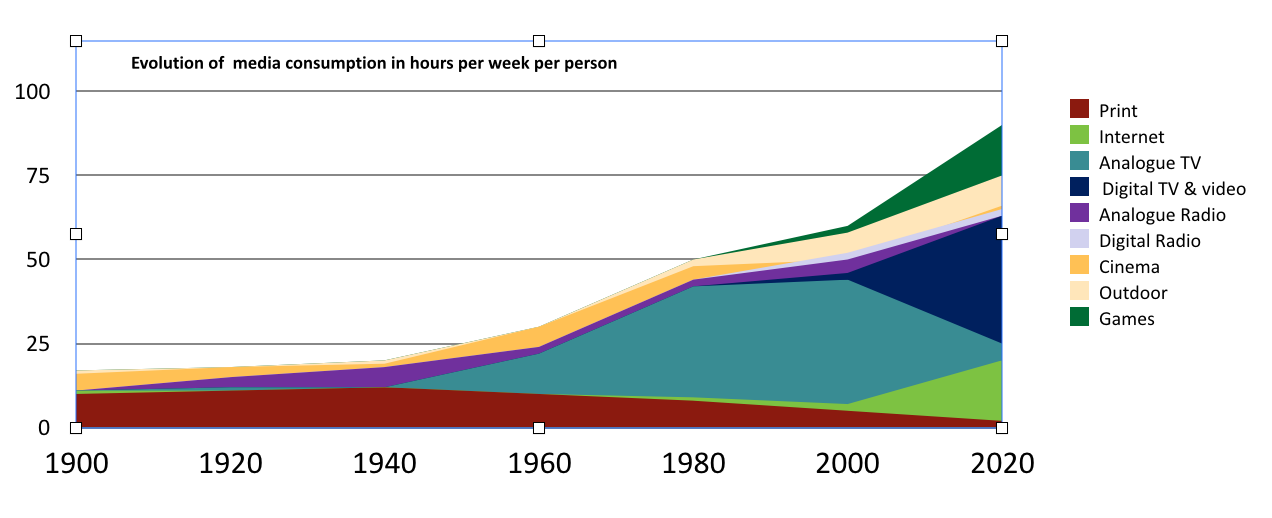
    Any type of vehicles that carry information can be considered media that can influence our view of the world: publisher platforms, social media, word-of-mouth, goodies, branded content, sponsoring, endorsement, influencer program, video games… The number of media vehicles available not only have increased but their « quality » -or trustworthiness- vary greatly.

    Graph of the evolution of media offer – based on a Perspective graph edited by Carat in 2008

    Where ‘Message’ is the content that is transmitted.

    Messages can take the form of news, educational content, stories, anecdotes, satires, propaganda, advertising, and so on…

    What are the characteristics of Media?

    • Shelf-life: Each medium has a length of time impact: where an outdoor poster can stay up for a month to be seen 60 times by commuters. A social media post would have a few hours – if not minutes – of impact to be seen once by an audience.
    • Memorizing stickiness: Each vehicule needs a number of repetition before the message sticks, where 75% of cinema goers remember an ad in one shot, TV needs of 3 to 4 to reach the same.
    • Engagement: Each vehicle can instil specific action or response; like create curiosity, provoque a reaction, searching about a product, participating into a poll, keeping an information top of mind for a few hours, or just build trust.
    • Image: Each vehicle has a perceived image by the public: trustworthy, statutory, specialised, entertaining, the choice of media and so on..
    • Reach: Each medium has a particular capacity to reach an audience over a limited period on time.
    • Message complexity: Each vehicle carries a specific depth of details: where print permits long explanations, display ads allow only short headlines.

    The combination of these characteristics plus the study of the audience to address is the basis for the media strategist to advise on the best vehicle to use for a specific communication objective.

    Nowadays – with the fragmentation of media channels – it is sensible to involve the media agency into the creative process to ensure that the message is related in the relevant way for the environment.

    This will be the topic in our next post, stay tuned.

  • CSR for small business

    I have realised – over the past decade – how fast the concerns over the impact of business on our society and planet has emerge as a topic for every type of business. Big or small, leaders are now required to « care » more than ever.
    From Child labor to #equalpay, from recycling to education for all, companies can have an amazing role in contributing while improving their balance sheet. This is a quick guide on how to kick start your initiative.

    Combining this with the emerging capacity to check on companies promises vs their engagements and values; it is becoming more and more difficult to present a strait face and propose nothing.

    • It does not look good to future clients,
    • it does not look good for future employees,
    • it does not look good as a business leader in its field.

    What is CSR ?

    Corporate Social Responsibility = is a self regulation that aims to contribute to a better relation between a private business and its environment (physical or social) : it gives room for business to take an active part into societal, environmental and philanthropic projects as landmark of their engagement.

    Keep in mind that CSR is not a cost line, it is an approach that can change some company set ups. It would actually lead to savings, lower employees’ turn over and greater business prospects (studies shows)

    Why is CSR good?

    Because any longe term planner knows that to keep a business floating, it needs a healthy working environment. And green washing is not a fix. Large businesses are looking into their partners to offer some of their own CSR relief (see guide below) so small businesses have to come equipped with solutions on their field of activity. it won’t be a competitive advantage, but it could soon be a form of obligation. 

    Once out of the pack thanks to CSR, your business can leverage it with its clients and new businesses

    But where to start ?

    Let’s build up a simple step-by-step guide on the low hanging fruits towards building a no-nonsense CSR plan that can also gives you an edge in terms of business:

    1. Review your internal processes
      • Do you consume intrant material? water? chemicals? power? Can this consumption be reduced?
      • Do you generate waste? what is done with it?
      • Where is your office, how employees come to work? where do they eat?
    2. Review your external partnerships
      • What are your providers certification and environmental labels ?
      • Do they have their own CSR plan?
      • Have you set up requirements for them?
    3. Engage your employees
      • Are your employees feeling concerned by CSR?
      • Is your appraisal process including CSR questions ?
      • Does any of your employees already leading an initiative or willing to participate into developing one?
    4. Choose your engagements
      • Which of your company values resonate with environmental issue?
      • Does your industry struggle with a particular societal problem?
      • Does your office / business is located in an area which could benefit from local support?

    Building this analysis can lead to clear first steps to improve the company impact, your providers relationships and the employees engagement. Maybe nothing clear emerges straightaway? Then we can suggest to help with a workshop session aiming to define long term company goals around positive issues based on the analysis. We believe that one day of focus can unleash a great set of empowering propositions to place your business in the right universe of work for good.

    Do not hesitate to be in touch.

  • Building employer’s image

    Companies can spend a lot on their human resources without major results or improvement as they do not always align their recruitment strategy and corporate culture to the type of employees they wish to recruit and keep.

    Two sets of benefits are usually considered:
    Financial benefits and incentives
    – Pay
    – Bonus
    – Health insurance
    – Stocks or shares
    – Pension funds
    Non financial benefits
    – Working culture : flexible hours and or work space, horizontal, collaboration, rewards
    – Employee development plan: training development program, etc.
    – Offices, infrastructures and working material
    – Diversity of missions and tasks
    – Perks : gym membership, transportation cards or credits

    Companies believed in the right combination of financial and perks to build the right market traction to the desired talents. Developing an employment branding requires to establish the HR strategy that will define the pillars of the communications.

    This HR strategy includes to work on the following aspect before being able to move forward on establishing this communication strategy.

    1. Understanding the Company current working culture and habits, image to candidates and employees.
    2. Assess their needs and opportunities to improve -> can something be changed, improved or stopped within the current process.
    3. Defining the type of profile the company wishes to attract and retain on the short and long term
    4. Understanding the type of benefits and perks these ideal talents are attracted by.
    5. Assessing the market and competition to define the right packages.

    Historically, employees used to focus on long term objectives appreciating good pension fund or health, clear career steps and loyalty from employers, accepting lower revenues or other benefits in exchange of security and visibility.

    Now Millennials are constantly on the look up for better opportunities, the most talented are not risk averse. Their loyalty is not only based on the money making potential of a job, but also the pride and attractiveness of the company name in the eyes of their community.

    With the emergence of crowdsourced content management on social media and web platforms, any candidates can check the credentials of companies as potential employers – how their business behave on the market, with its employees and clients and what is their general footprint on the market.

    Ambitious companies – whatever their size – cannot afford anymore to overlook their HR strategy if they wish to ease and save money on their recruitment processes.

    That is to say, companies now have to « walk the talk » to convince their young talent to engage with them and participate into the process, as well as present a leverage to increase loyalty hence reducing turnover.

    Then the strategy team can move forward on work the communication brief to address HR related topics starting with :

    • Get adoption from the management for the needs and reasons to implement a company employment branding
    • Define the relevant environments and subjects that resonate with your desired recruits and market.
    • Build an internal messaging and benefit for current employees which includes their participation into the strategy – internal engagement is the most powerful recruitment tool.
    • Set up the company external communications channels
    • Develop a dashboard presenting the relevant KPIs of the business for HR communication to pilot the strategy.

    We are happy to provide you more guidance on the preparation and the implementation of your employment branding. Contact me anytime.

  • Finding the right team members

    “We need to hire someone more senior for this role” is a phrase I have heard my whole agency life. But what means “being senior” in a business,

    “We need to hire someone more senior for this role” is a phrase I have heard my whole agency life. Often, the choice is right and the person fulfil her role with professionalism. Still, we sometimes end up with a deceptive and ill-adapted solution where the person is not equipped to fill it mission, however senior s.he is.

    This can have a devastating on the level of service on the short term and quality of the business relationship on the long run, I have experienced it first hand lately and it took me to reflect on the roots of the problem we faced.

    Why recruitment does not always work and how to address it?

    Analysing the internal issues we faced, I realised that this seniority definition is divided into the following pillars:

    • Expertise/ Skillset: based on the pure technical know how and specificities of an industry or a solution. Someone who is certified or accredited in a particular area of work. The more senior one’s get the deeper one’s knowledge is.
    • Experience: based on the length of someone’s acquaintance with a sector, a role or a situational environment which makes one’s knowledge about the potential outcome and necessities of the future role.
    • Values: based on the capacity to take ownership of a role and resolve to address any issues coming with it, including potentially managing team members.

    I gather that each role does not require to reach the same level in each of these pillars. But the company needs have to be clear what the job requires.

    How do you get the assessment right ? I read a lot of HR and Coaching blog to address this and the actual best advice I found is the following: Use your team members to confirm and clarify the role needs and values as the doers are the best persons to understand the role needed and the mistakes not to be made (again).

    That includes :

    • Build a precise role description
    • Advertise it properly: internally and externally
    • Assess the applicant on those necessary pillars:
      • Expertise : check it skills with a test – does he have to master excel ? web based and/or collaborative tools ?
      • Experience: check with its old employer and work history
      • Persona : how does he cope with stress ? with other team members ? with stakeholders at all levels of the hierarchy ?
    • Do not underestimate practicalities : other job offers ? does he have to move in town ? where is his.her family?

    As a manager, it is essential to clarify if your HR process is covering these 4 elements or needs to be cover by you. at the end of the day, the manager can sometimes « inherit » a team member he has not selected and end up not being able to keep its standard of service and productivity because of an ill prepared recruitment process.

    When recruiting for your company is difficult, it can also emerge from the external outlook of your company as a good place to work.

    Large businesses address this as part of their corporate communications strategy to support recruitment effort of qualified personnel.

    If you are facing recruitment issues, and need support in building a recruitment strategy, do not hesitate to share your questions with us. we are always happy to help.